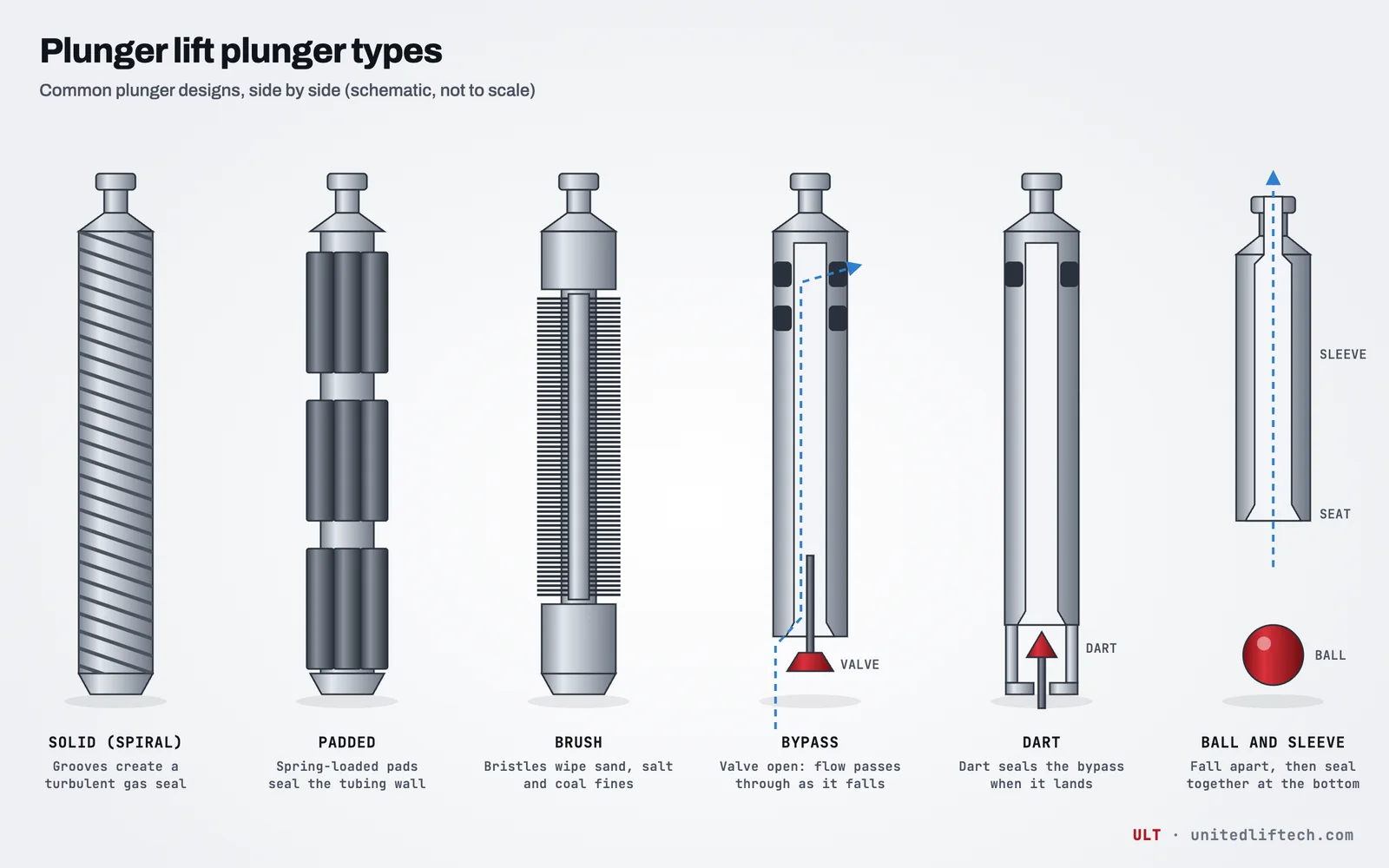
Plungers differ in two ways: how they seal against the tubing, and how they fall. Solid, padded and brush plungers are conventional plungers that seal with grooves, spring-loaded pads or bristles and need the well shut in to fall. Bypass plungers, including dart and sliding sleeve designs, have an internal flow path that is open on the way down, so they fall quickly with the well still flowing. Ball and sleeve (two-piece) plungers fall as two separate parts and seal when they meet at the bottom. Choose by gas rate, solids, tubing condition and how much shut-in time the well can afford.
What a plunger has to do
On every trip, the plunger forms a moving seal between the gas below it and the liquid above it. A good seal means little gas slips past on the way up and little liquid falls back, so each cycle lifts more liquid for less stored pressure. The plunger also has to fall back to the bottom quickly, survive hitting the bumper spring and the lubricator thousands of times, and keep the tubing wall clean of paraffin and scale. No single design does all of this best, which is why there are several types. See how plunger lift works for the full cycle.
Conventional plungers
Conventional plungers are solid bodies with no valve. They fall through the gas and liquid in the tubing while the motor valve is closed, so the well must be shut in for long enough for them to reach the bottom.
Solid (spiral) plunger
A one-piece steel bar with spiral or ringed grooves cut along its length. The grooves make the gas slipping past swirl and lose pressure, which forms a turbulent seal. With no moving parts it is the toughest and simplest plunger, it tolerates fast arrivals, and it suits wells with low to moderate gas volumes. Its seal is less tight than a padded plunger's, so it needs a little more energy per cycle.
Padded plunger
Spring-loaded steel pads around a central mandrel push out against the tubing wall, giving a mechanical seal. The pads follow small changes in tubing diameter, so a padded plunger seals better than a solid one and lets less liquid fall back, which makes the most of a weak well's energy. The pads and springs wear and can break with very fast arrivals or in sandy wells.
Brush plunger
A section of stiff synthetic bristles around the mandrel seals against the tubing. The brush wipes past sand, salt, coal fines and rough or slightly damaged tubing that would wear out pads or score a solid plunger. It is the usual choice for wells producing solids. Bristles wear faster than steel, so check them more often.
Combination and ring plungers
Many plungers combine sections, for example pads with a brush section, or use sets of interlocking rings that expand against the tubing. They trade the strengths of each seal type for a particular well.
Bypass (continuous flow) plungers
A bypass plunger has ports and an internal flow path. On the way down the bypass is open, so gas and liquid flow through the plunger instead of holding it up, and it falls quickly even with the well flowing. When it lands on the bumper spring at the bottom, the impact closes the valve and it becomes a sealed plunger. The gas pushes it up, and when it arrives at surface a rod in the lubricator knocks the valve open again, ready for the next fall.
Because it can fall against flow, a bypass plunger needs little or no shut-in, so the well spends more of the day producing. It suits higher-rate gas wells where gas velocity is high enough to carry liquid most of the time. ULT's continuous flow plunger is designed for gas velocities of 10 ft/s and above and falls at up to 360 ft/min.
Dart plunger
A dart plunger is a bypass plunger whose valve is a dart held in a cage at the bottom. Landing on the bumper spring drives the dart up to seal the flow path; the lubricator rod pushes it back down to open it at surface.
Sliding sleeve plunger
Here the valve is a sleeve that slides over the bypass ports: it shifts closed at the bottom and is shifted open at surface. It works the same way as a dart plunger with a different valve.
Ball and sleeve (two-piece) plungers
A two-piece plunger is a hollow sleeve and a separate ball. Apart, each piece falls very quickly through the flowing well, because gas passes through the open sleeve and around the ball. At the bottom the sleeve lands on the ball, the two seal together and the gas lifts them as one. At surface the lubricator separates them, and they fall again with almost no shut-in. Two-piece plungers make the most trips per day of any type and suit wells with enough gas to keep flowing between trips.
Intelligent plungers
An intelligent plunger has sensors built in. ULT's intelligent plungers record temperature, pressure and acceleration on every trip, which lets the controller estimate the liquid column and tune the next cycle. They come in several designs, sizes and materials.
How to choose a plunger
| Well condition | Plunger to consider | Why |
|---|---|---|
| Low to moderate gas volume, clean well | Solid (spiral) | Simple and durable, tolerates fast arrivals |
| Weak well that needs every bit of seal | Padded | Tighter seal, less liquid fallback |
| Sand, salt or coal fines; rough tubing | Brush | Bristles wipe past solids and worn tubing |
| Higher-rate gas well, little shut-in time to spare | Bypass, dart or sliding sleeve | Falls against flow, so the well keeps producing |
| Strong gas well loading up between trips | Ball and sleeve (two-piece) | Fastest fall and the most trips per day |
| Need to see what happens downhole | Intelligent plunger | Logs conditions on every trip for the controller |
Many operators start with a simple, durable plunger, learn the well's behaviour, then move to a design that seals better or falls faster once the cycle is stable. Tubing condition matters as much as the well: a plunger only seals as well as the tubing it runs in, and tight spots, crimped joints or scale stop it falling.
Sizes and materials
Plungers are made to fit the tubing. ULT plungers come in 2-3/8, 2-7/8, 3-1/2 and 4 in sizes, with a standard API fishing neck for retrieval, a choice of materials and temperature ratings, and corrosion-resistant options for sour service.