A hydraulic jet pump pumps high-pressure power fluid down the well to a nozzle. The nozzle turns that pressure into a high-velocity jet, which creates low pressure that draws well fluid into the pump. The two fluids mix in the throat, and the diffuser slows the mixture down, turning its velocity back into the pressure needed to lift it to surface. There are no moving parts downhole.
The three parts that do the work
A jet pump works on the same principle as a garden hose sprayer or a laboratory aspirator: a fast-moving fluid has lower pressure than a slow one.
| Part | What happens there |
|---|---|
| Nozzle | High-pressure power fluid accelerates through a small opening, converting pressure into velocity |
| Throat (mixing tube) | The fast, low-pressure jet draws in formation fluid from the pump intake, and the two mix and exchange momentum |
| Diffuser | The flow area widens gradually, slowing the mixture and turning its velocity back into pressure to lift it to surface |
The 3D cutaway above shows power fluid going through all three, and the check valve and screen at the intake.
How the power fluid gets down and back
A jet pump needs a path for power fluid to go down to the pump and for the combined fluid to come back up. The two common layouts are:
- Concentric tubing. Power fluid goes down an inner tubing string and the mixed production returns up the annulus between the inner and outer strings. This is the layout the ULT jet pump uses, with a dual concentric tubing string.
- Casing return. Power fluid goes down the tubing and production returns up the casing annulus, with a packer to seal below the pump.
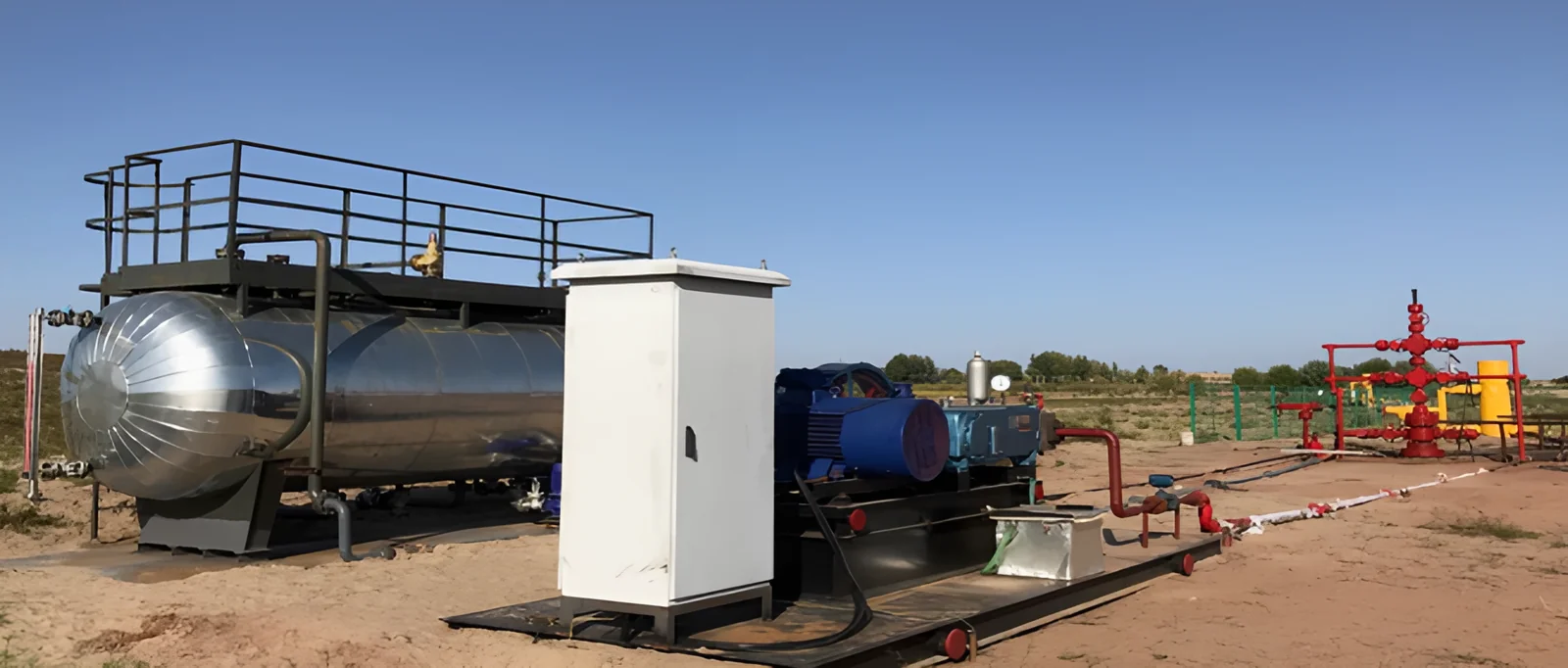
On surface, a high-pressure plunger pump driven by a variable speed drive supplies the power fluid, usually water or oil separated from the well's own production. A separator splits the returning fluid, the produced volume goes to sales and the rest goes back to the power fluid pump.
Many jet pumps are free pumps: reversing the direction of circulation pushes the pump core back to surface, so the nozzle and throat can be changed without a rig.
Nozzle and throat sizing
The ratio between the nozzle area and the throat area decides how the pump behaves:
- A large nozzle in a small throat gives high lift (head) at a lower production rate. It suits deep wells and low intake pressures.
- A small nozzle in a large throat gives high production at lower lift. It suits shallower wells with good intake pressure.
Because the nozzle and throat are small, replaceable parts, a jet pump can be resized as the well changes simply by changing them, and fine-tuned from surface by changing power fluid pressure and rate.
Cavitation: the jet pump's main limit
The jet creates very low pressure at the throat entrance. If the pump tries to produce more fluid than the intake pressure can supply, the pressure there falls below the fluid's vapour pressure, vapour bubbles form and then collapse violently. This is cavitation, and it erodes the throat quickly.
Avoiding it means keeping enough pump intake pressure for the production rate you want, choosing the right nozzle and throat combination, and not over-driving the pump with excess power fluid. Monitoring pump intake pressure, as the ULT system does with a downhole pressure gauge, shows how close the pump is to the limit.
Where a jet pump is the right choice
Jet pumps suit wells that are hard on other lift methods:
- Sand. With no moving parts downhole, there is nothing for sand to wear or jam. The ULT jet pump handles particles up to 2 mm.
- Deviated and horizontal wells. There are no rods to wear against the tubing, so inclination up to 90° is not a problem.
- Gassy wells. A jet pump does not gas lock the way a positive displacement pump can, which also makes it useful for dewatering gas wells.
- Heavy oil and treatment. The power fluid can carry heat, diluent, corrosion inhibitors and scale-control chemicals straight to the pump.
- Changing conditions. Rate is adjusted from surface, and the pump can be resized without a rig.
The trade-off is energy. A jet pump's hydraulic efficiency is lower than a rod pump's, because turbulent mixing in the throat loses energy, and it needs surface equipment to handle the power fluid. In a straight, clean, liquid-rich well, a rod pump is usually more efficient. For a full comparison, see choosing an artificial lift method.